Monday, April 18, 2016

HW12.2.2 Physical Computing Artist Research: Jim Campbell

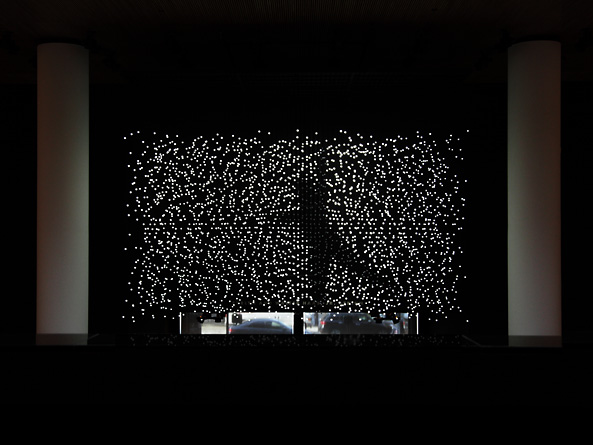
Jim Campbell is an artist that uses physical computing to instill energy and form into light and shadow.  Using over 2000 LED lights, Campbell hung them from a grid using wires to create a 16x20x11 ft canvas of lights.  The entire work was hung from the ceiling in an expansive room so that the lights floated above the heads of viewers.  On their own, the LED lights mimic stars in the nighttime sky and have a delicate randomness in their order.  However, the lights also act as a cinematic screen for playful shadow images.  The LED lights have been programmed to dim and create the outlines of human figures.  The use of negative space in the formation of the figures is an interesting element that adds to the unique three-dimensional LED form.


Source:
http://www.jimcampbell.tv/portfolio/public_art/exploded_views/

Tuesday, April 12, 2016

HW11.5 Student Teacher Response

Listening to the three student teachers who spoke during our last class, I was surprised to hear how little new media is actually used in classrooms.  After being in this class all semester, I have become so accustomed to new media tools and projects that I had forgotten that most art classrooms rarely utilize them.  I enjoyed hearing the pros and cons of new media from people who have used it firsthand.  I thought it was interesting that the stop-motion program was only on some of the school's computers, forcing the students to work in groups around a single computer.  The lack of supplies isn't ideal, but hearing about the students' teamwork and collective participation as a result was reassuring.

HW11.4 Sound Lesson Plan

Age Group: High school students in groups of 3-5

Time: 3 hours or 3 class sessions

Objective: Students will learn to use storytelling, sound editing, and non-visual means of expression.

Materials: Audio recorders (possibly smart phones), paper, pens, sound editing software

Activity: Students will choose a classic fairytale (e.g. The Three Little Pigs, Hansel and Gretel).  Students will then map out the story and record audio including narration and sound fx.  The students will then edit the audio into a 10-15 minute track.

Questions: What was the most challenging part of the project?  Was it difficult to create a vibrant narrative using only audio? Did you use the editing software to change the original recorded sounds and did that affect the project?
HW11.3 Blank Assignment

For my blank assignment, I returned to working with sound.  This time however, instead of working with sounds that I created, I used sounds that I downloaded from the website freesound.org.  I downloaded different versions of laughter from different users on the website.  Together, they create an alternative sort of laugh track, like those used on sitcoms.  There are very different styles of laughter from children to individual men to large groups of people laughing.  I played around with the echo and reverb features to distort the laughter towards the end.  I wanted all of the laughs to combine into a sort of white noise.

HW11.2.2 3D Printing Artist Research: Morehshin Allahyari


Morehshin Allahyari created a 3D printed art project in response to the 2015 destruction of ancient artifacts at the Mosul Museum in Iraq.  The original statues from the Roman period city of Hatra and Assyrian artifacts from Nineveh were destroyed by Islamic State extremists with sledgehammers.  The Mosul Museum kept no catalog of their collection and little information is available on the destroyed pieces of antiquity.  Through her research, Allahyari was able to find old scanned photographs of some of the destroyed objects.  Although 3D printed models are usually made using multiple photos from different angles, Allahyari worked with what she had and created models based off of the old photos.  The collection of 3D printed images is called Material Speculation: ISIS and each work was made using clear filament.  Within each objects, a memory card is lodged which holds the 3D model design along with images, maps, pdf files, and videos relating to the history of the original artifact.


Sources:
http://www.morehshin.com/material-speculation-isis/
http://www.dailydot.com/technology/isis-3d-printing/

HW11.2.1 3D Printing Artist Research: Ji Lee


Ji Lee is an artist who used 3D printing to create a public art project.  His work, Mysterabbit, is a series of 10,000 identical, tiny bunny statues.  The bunnies are shown in a mediative pose and are placed in random spots around the world.  Mysterabbits have been found in South Korea, Iceland, and even the United States.  The purpose of the project is to stop people in their daily routines and allow them a moment of joy and surprise when they come across the small hidden rabbit in public.  By using a 3D printer to create this project, Lee was able to make the project a truly "public" work.  The 3D model is available for free on its own website and people are encouraged to print their own meditating bunnies and add to the project.

Ji Lee's photo / unknown / unknown
Jay Ward's photo / Keystone / United States
Tomáš Kůrka's photo / Praha 7 / Czech Republic
Tomáš Kůrka's photo / Praha 2 / Czech Republic
Sources:
http://www.mysterabbit.com/about
http://www.huffingtonpost.com/2014/06/30/3d-printing-art_n_5534459.html

HW11.1 3D Printing


Using the Tinkerbot program to create the model for my 3D printed object was more difficult than I expected.  I assumed that the program would have more shapes and options available, but it was up to me to build the model from a few very basic shapes.  This makes sense, but it took more time and effort than I thought it would considering my object is fairly simple.  The printing process itself was very easy and I loved that you could scale the object to any size.  My object only took about seven minutes to print and it came out just as I imagined.