Tuesday, March 29, 2016

HW9.3.2 Programming Artist Research: Nick Briz

Nick Briz is an artist who uses programming to create algorithms for art and tear apart code in order to create glitches.  In his work, The Coldplay Song Generator, he used code to create an application which creates new songs based on the patterns and formulas of the band Coldplay.

The application can be downloaded on his website.

He also works with Glitch Art, which is a form of art that is interested in the visual results of mistakes and error in code.  Briz creates digital works that actively have "badly" written code in order to produce the glitches.  Because they are actively desired, the glitches cease to be seen as mistakes and become the focus of the work.  In order to make glitches appear in specific ways, the code must be written precisely, so although it is filled with "errors," it still requires extreme programming knowledge and skill.

From The Ground Up In Order, Embrace from Nick Briz on Vimeo.


Sources:
http://nickbriz.com/
http://artcopyright.interartive.org/coldplay-song-generator-copy-drive-sample-chest/

HW9.3.1 Programming Artist Research: Raven Kwok

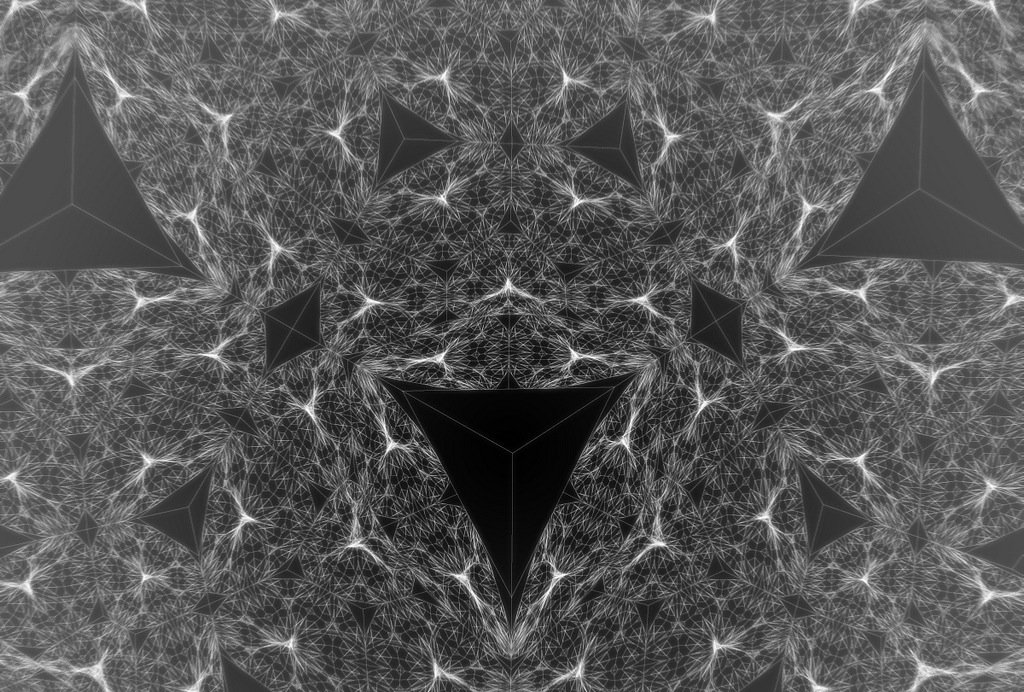
Raven Kwok is a Chinese artist who uses programming to create works of art.  Kwok works with the programming software and language known as Processing.  Many of his works are studies on fractals and patterns, but others are playful uses of internet memes.

 
Sources:
http://www.creativeapplications.net/processing/115c8-and-edf0-by-raven-kwok-recursive-and-transforming/
http://thenextweb.com/dd/2012/07/14/if-you-like-programming-and-fine-art-you-will-love-raven-kwoks-work-made-with-processing/#gref

Tuesday, March 22, 2016

HW8.1 Sound Project

For this sound piece I recorded the sound of water running in the sink, myself eating crackers, drinking water, and pouring water into a cup.  I liked the sound of the crackers crunching and I looped them over and over as if I were eating a whole box of crackers.  The crackers made me thirsty so the rest of my project was associated with water and the fulfillment of thirst.


HW8.3 Sound Reflection

By observing the sounds around me, I have realized that sound is a constant stimuli and the brain has learned to ignore all but the most important noises.  As I type this blog post, my fingers are making tapping sounds on the keys of my computer and I can hear my desk shaking slightly with each sudden move.  These sounds are so common in my mind, that I have stopped noticing them except for the rare cases that I open my mind to them.

When I think of sound in the classroom, I am immediately reminded of the many tricks I have seen teachers use to quiet down a bustling group of students.  Teachers will begin to stage whisper, hoping their students will quiet in an effort to understand them or use the "If you can hear me clap once" tactic.  I have recently had a professor in a Teachers College class use a gong to call the attention of the class after a series of group discussions.  The gong was strange sound to hear in a classroom setting and it caught the attention of everyone in the room.  Teachers often use incongruous sounds to attract student attention, but there are so many sounds in the classroom that few of them can be seen as incongruous.  It is commonplace to hear air conditioners, heaters, footsteps in the hall, fire trucks and ambulances in the streets below, and construction workers on the sidewalks outside.  With so many sounds in the ears of a student, it is a miracle that any of them hear the teacher's lesson and remain attentive.

Monday, March 21, 2016

HW8.2.2 Sound Artist Research: Miya Masaoka

Miya Masaoka is a musician and performance artist who has worked with insects in some of her sound pieces.  From 1996 to 2001, Masaoka worked on The Bee Project.  She created a score that instructed how the sound in the work would be manipulated by a mixer.  The sound that she applied to the score, was the buzz of 3,000 live bees in a glass beehive on the stage of the performance space.  Distorting the sound of the bees in real time and projecting the result back into the room showcased the immediate power of sound work and highlighted the contrast between the wild, natural bees and the calculated, synthetic remix.

Masaoka continued to work with bees and created a short video, Adventures of the Solitary Bee.  In it, the sound of bees is overlaid with a musical score written by Masaoka and narration discussing the physical and philosophical life of bees.


Sources:
http://www.miyamasaoka.com/interdisciplinary/skin_insects/index.html

HW8.2.1 Sound Artist Research: Alvin Lucier

Alvin Lucier is an artist who uses sound and recordings in his work.  Several years ago, I became aware of his work, I Am Sitting in a Room.  The original work consisted of Lucier sitting in a room with a microphone and a tape recorder.  He narrated a pre-conceived statement into the microphone saying, “I am sitting in a room, different from the one you are in now. I am recording the sound of my speaking voice...” and so on.  Once he finished speaking his statement, the recorded tape was played into the room while being recorded on to a new tape.  Then the new recording was played and recorded.  This happened again and again for forty-five minutes.  At first the recordings sound like faithful portrayals of Lucier's original statement.  Eventually, like a document that has been photocopied far too many times, the recordings begin to develop distortions.  Certain frequencies began to emerge and are made more prominent with each new recording.  By the end of the work, Lucier's original statement is no longer decipherable.  The recordings result in a droning static hum that represents the ambient sound existing in the room.  Lucier's work is especially interesting due to his speech impediment.  As a man with a stutter, Lucier was familiar with oratory distortions and may have been inspired by them.  His stutter makes a small appearance in I Am Sitting in a Room, but is erased along with the rest of his speech in the final product.


Sources:
http://www.moma.org/explore/inside_out/2015/01/20/collecting-alvin-luciers-i-am-sitting-in-a-room/
http://www.npr.org/sections/13.7/2014/10/17/356999444/what-art-and-the-game-telephone-teach-us-about-copying-speech?utm_source=facebook.com&utm_medium=social&utm_campaign=npr&utm_term=nprnews&utm_content=2041

Tuesday, March 8, 2016

HW7.2.1 Video Artist Research: Bruce Nauman

Bruce Nauman is one of my favorite artists and he often works with video in his art.  I love many of his video works, especially those that deal with video surveillance and include live video of the audience as they interact with the work, but for this post I will focus on Revolving Upside Down.  In a famous quote from an interview with Ian Wallace and Russell Keziere, Nauman said "If I was an artist and I was in the studio, then whatever I was doing in the studio must be art."  This is an interesting concept that immediately drew me to Nauman and is clearly seen in many of his videos.  Nauman often used video as a means of simply recording his actions as an artist in the studio.  He would perform extremely banal actions, such as walking seen in the video below, but because he was an artist in the studio, he considered the actions to be art.


Walking in an Exaggerated Manner Around the Perimeter of a Square

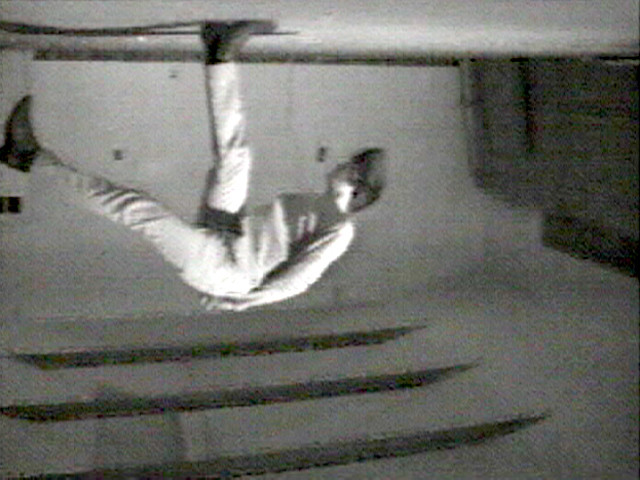
In Revolving Upside Down though, Nauman rotated the video camera so that his normally mundane activity, pivoting on one foot, appeared as a gravity-defying act.  The camera recorded his movements upside down and completely changed the affect of the work.  Nauman utilized the camera as more than a neutral observer and allowed it to influence the final work.


Sources:
http://www.vdb.org/titles/revolving-upside-down
http://whitecube.com/exhibitions/bruce_nauman_inside_the_white_cube_2012/
http://www.moma.org/collection/works/120629?locale=en